What size is an ACEO?
An ACEO is always 2.5 × 3.5 inches — the exact dimensions of a standard trading card. That fixed size is the one unbreakable rule of the format. Here it is in every unit you might need, the pixel dimensions for digital work, and why the size matters so much.
ACEO size in every unit.
2.5 × 3.5 inches, converted. Width is listed first, then height, in the usual portrait orientation.
| Unit | Width | Height |
|---|---|---|
| Inches | 2.5″ | 3.5″ |
| Centimetres | 6.35 cm | 8.89 cm |
| Millimetres | 63.5 mm | 88.9 mm |
| Points (72/in) | 180 pt | 252 pt |
| Pixels @ 300 DPI | 750 px | 1050 px |
Working in metric? Many artists round to 6.4 × 8.9 cm (64 × 89 mm) — close enough that the card still fits standard sleeves.
ACEO size in pixels.
There's no single pixel size — it depends on the resolution (DPI) you're working at. Set your canvas to match how the card will be printed.
- Print editions: work at 300 DPI — a 750 × 1050 px canvas. This is the safe default for giclée and home printing.
- Sharper detail: 600 DPI gives 1500 × 2100 px for fine linework and small text.
- Screen / previews only: 72 PPI is 180 × 252 px — never print from this.
- Add bleed for prints: extend the artwork 1/8″ (0.125") past every edge so trimming leaves no white slivers — at 300 DPI design at 825 × 1125 px, then cut back to 750 × 1050.
| Resolution | Pixels (W × H) | Use |
|---|---|---|
| 72 PPI | 180 × 252 | Screen / preview |
| 150 DPI | 375 × 525 | Draft print |
| 300 DPI | 750 × 1050 | Standard print |
| 600 DPI | 1500 × 2100 | Fine detail |
| 300 + bleed | 825 × 1125 | Print w/ trim |
Why the size is fixed.
The standard isn't arbitrary — it borrows the universal trading-card footprint, and that unlocks a whole ecosystem of storage and display.
ACEO size vs ATCs & trading cards.
People searching for the ACEO size often wonder how it lines up with ATCs and collectible cards. Almost everything shares the same footprint.
| Format | Size | Same as an ACEO? |
|---|---|---|
| ACEO | 2.5 × 3.5″ | — the standard |
| ATC (Artist Trading Card) | 2.5 × 3.5″ | Yes — identical size |
| Sports / trading card | 2.5 × 3.5″ | Yes — identical size |
| Poker playing card | 2.5 × 3.5″ | Yes — identical size |
| Bridge playing card | 2.25 × 3.5″ | Slightly narrower |
So an ACEO and an ATC are exactly the same size — the difference is what you do with them: ACEOs are sold, ATCs are traded. Full breakdown on What Is an ACEO.
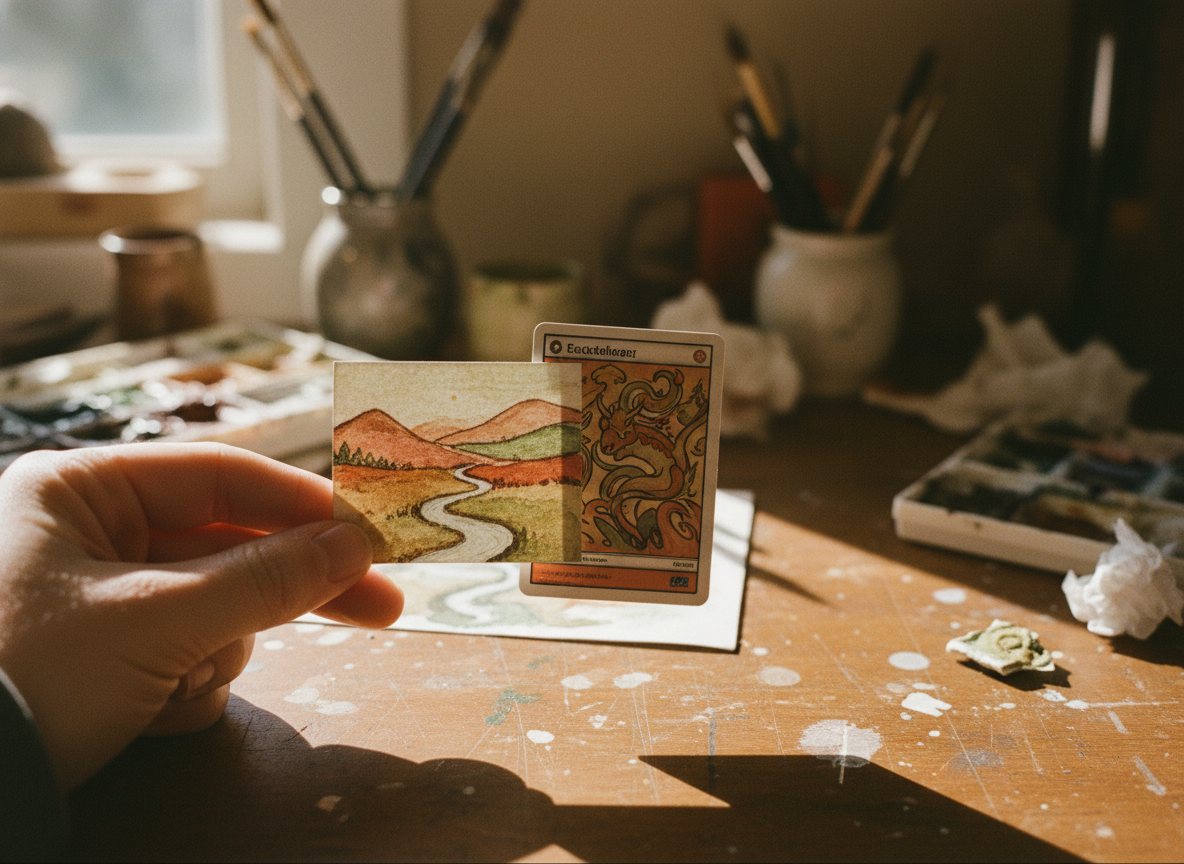
Cutting to size accurately.
The size only works if it's precise. A card that's even a little off won't sit right in a sleeve or binder page.
- Cut with a craft knife and a metal ruler, or a guillotine/rotary trimmer with a measured stop — not scissors.
- Keep a 2.5 × 3.5 template (or a spare trading card) to trace and check every card against.
- Measure twice, cut once. Trimming a fraction off is easy; adding it back isn't.
- Orientation is up to you — portrait or landscape — as long as the footprint stays 2.5 × 3.5.
- Test-fit the finished card in a sleeve or toploader before you list or ship it.
ACEO size FAQ.
What size is an ACEO?
Always 2.5 × 3.5 inches (63.5 × 88.9 mm) — the size of a standard trading card. It's the one fixed rule of the format.
What is that in cm and mm?
6.35 × 8.89 cm, or 63.5 × 88.9 mm. Rounding to 6.4 × 8.9 cm is fine in practice.
What size in pixels for digital?
750 × 1050 px at 300 DPI for print. Use 1500 × 2100 at 600 DPI for fine detail, and add 1/8″ bleed for print editions.
Can an ACEO be a different size?
No — the 2.5 × 3.5 size is what makes it an ACEO. Any other size is just a small artwork, and it won't fit collectors' sleeves and binders.
Portrait or landscape?
Either. Only the 2.5 × 3.5 footprint is fixed — you choose whether the card stands vertical or lies horizontal.
Same size as an ATC?
Yes — identical. ACEOs, ATCs, and trading cards are all 2.5 × 3.5″. ACEOs are sold; ATCs are traded.
Ready to make one?
You know the dimensions cold. Next: pick a substrate, cut to a clean 2.5 × 3.5, and start creating. Our step-by-step guide and supplies list have you covered.